From Somalia to Canada, Dr. Fadumo Isse has built a career in science through determination and resilience. Now a postdoctoral fellow at the University of Alberta, she continues her groundbreaking research in women’s heart health after completing her PhD in pharmacy.
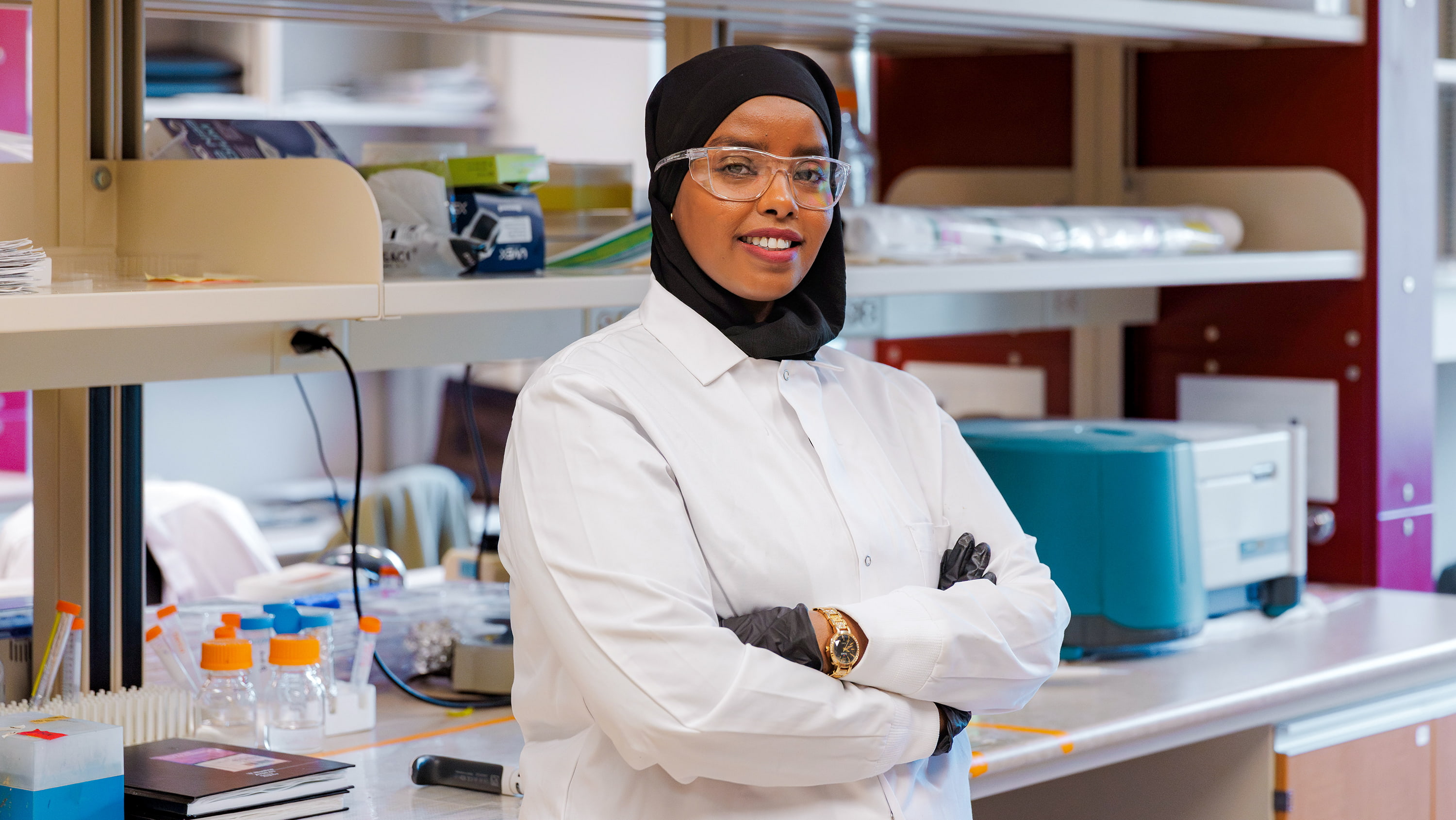 Pharmacy PhD graduate Fadumo Isse at the University of Alberta. (Photo: Alex Pugliese)
ALBERTA (Somali Report) — For Dr. Fadumo Isse, the path from Somalia to a PhD in pharmacy was never defined by comfort or ease. It was defined by persistence, discipline, and an early conviction that education would shape her life no matter the distance, the language barriers, or the countries she would have to cross to pursue it.
Now a newly graduated PhD researcher from the University of Alberta’s Faculty of Pharmacy and Pharmaceutical Sciences, Isse stands at the beginning of a postdoctoral fellowship focused on women’s heart health—continuing a scientific journey she describes as both demanding and deeply rewarding.
But behind the academic achievements and scientific publications lies a story of migration, resilience, and a steady determination that began in Somalia, where she grew up in a large family that quickly recognized one defining trait: she was “stubborn,” in the most affectionate sense of the word.
“They don’t mean stubborn in a bad way,” Isse says. “It’s more like they recognize that I am going to get educated no matter what, and circumstances will not deter me. Maybe ‘determined’ is more appropriate.”
That determination carried her across continents.
From a young age, Isse was drawn to learning. Unlike many children who divide their time between hobbies and play, she found joy in studying. Her father became one of her earliest and strongest supporters, encouraging her to pursue education as far as she could go.
“He was always the big motivator in my life to be an educated person,” she recalls. “He encouraged me to complete high school, go to university and potentially continue to graduate studies.”
His encouragement stayed with her even after his passing a decade ago, becoming a guiding force through every stage of her academic journey.
That journey first took her to Jordan, where she earned a scholarship to study at the Jordan University of Science and Technology. At just 18, she left Somalia alone to pursue a six-year Doctor of Pharmacy program, entering a new country, language, and culture.
It was her first real encounter with independence on such a scale. The transition was overwhelming at times, but also formative.
“I figured out this is my field. I loved it,” she says. “It is wonderful when you start something and then you realize, ‘Wow, I have huge passion in this area.’”
After completing her studies in Jordan, Isse’s academic journey took another major leap—this time across the Atlantic to Canada. She arrived at the University of Alberta in Edmonton through a scholarship supported by WUSC and the university.
The shift was drastic. Edmonton’s winter, unfamiliar systems, and cultural differences created an environment that demanded adaptation at every level.
“Volunteers helped us to get educated about winter and how to dress and prepare us, but still we were in shock,” she recalls. “The first winter was the hardest.”
Daily life required learning everything anew—from transportation systems to grocery routines. Yet even amid these challenges, Isse found stability in her academic work.
“I loved figuring out unknown questions about my project,” she says. “I loved generating data and translating it and linking it to improving care for real-world patients.”
Her entry into research began during her master’s program under Dr. Sherif Mahmoud, where she studied nimodipine, a drug used in treating hemorrhagic stroke patients. Her work focused on improving drug delivery to enhance patient outcomes.
That experience became a turning point.
“That’s when I confirmed my passion for research,” she says. “I loved figuring out unknown questions.”
She continued her academic progression into a PhD under the supervision of Dr. Ayman El-Kadi, whose laboratory studies lipid metabolism and cardiovascular health. There, Isse focused on developing analytical techniques to measure lipid metabolites and understand their role in heart disease.
Her research contributed to broader scientific efforts to identify how biological mechanisms influence cardiovascular conditions, including studies exploring how genetic pathways can be influenced to maintain heart health under stress.
Somali Report · Newsletter
Your morning briefing on Somalia's biggest stories — politics, security, business, and the people shaping the region's future.
“El-Kadi describes her as exceptionally motivated, independent, and detail-oriented,” noting that her productivity and leadership stood out throughout her doctoral training.
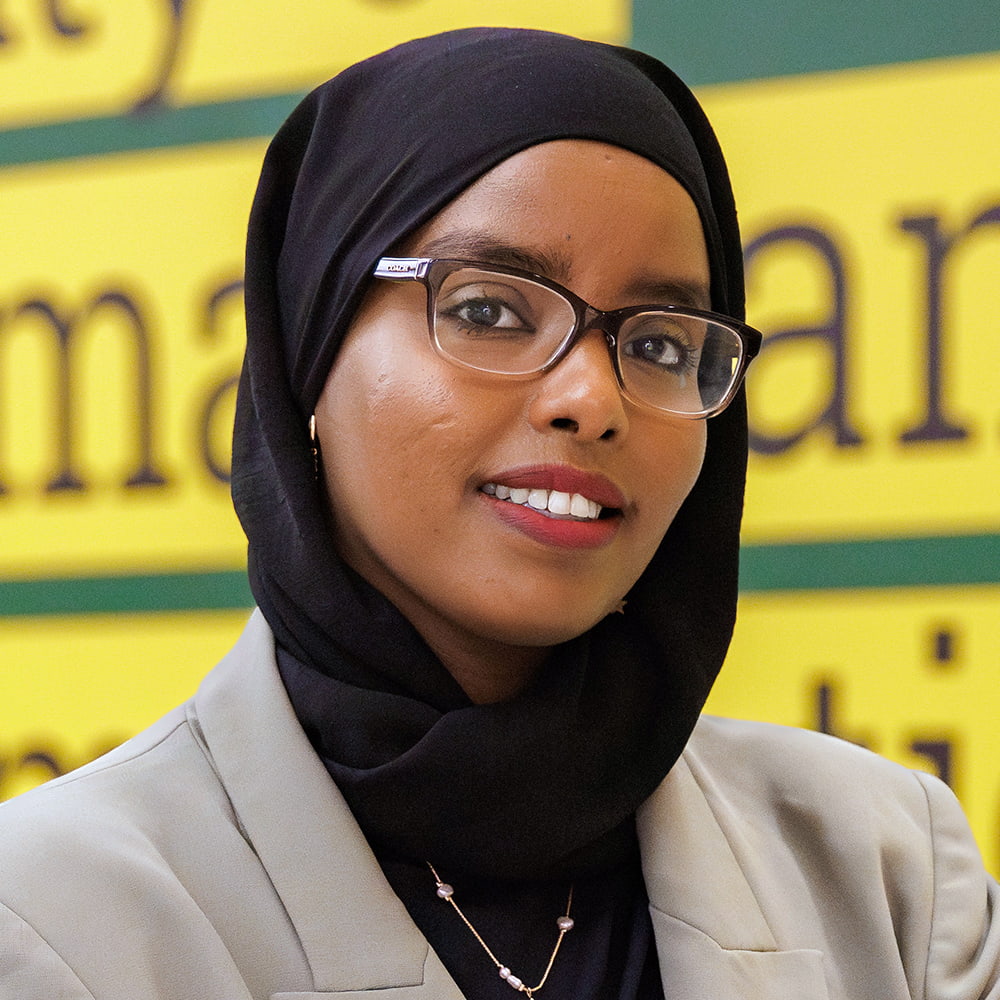 Pharmacy PhD graduate Fadumo Isse at the University of Alberta. (Photo: Alex Pugliese)
Now entering her postdoctoral stage, Isse is turning her attention to women’s cardiovascular health, a field that examines how biological differences affect disease risk and treatment.
Her current research explores how menopause impacts heart function, particularly the loss of estrogen’s protective effects and its link to cardiac hypertrophy.
“When women start to go into menopause, they lose the cardioprotective effect of estrogen,” she explains. “They are at higher risk of cardiovascular disease.”
It is work that bridges molecular science with real-world health challenges, aiming to improve outcomes for patients who are often underrepresented in clinical research.
Beyond the laboratory, Isse has consistently played an active role in supporting others. She has volunteered with international student services, served in student leadership positions, and contributed to community support organizations in Edmonton.
Her supervisor describes her as someone deeply committed not only to research but also to mentorship and community engagement.
“She is collaborative, compassionate and committed to mentorship and community service,” El-Kadi says.
For Isse, these roles are not separate from science but part of the same responsibility.
“I always tell them, ‘You can do it. Nothing is impossible. You just have to have the passion to continue,’” she says.
Over the years, Isse has received multiple academic awards and scholarships, including recognition from the Canadian Institutes of Health Research and Alberta Innovates, allowing her to continue her research trajectory.
But she measures success less by accolades and more by persistence through difficulty.
Pursuing a PhD far from home, she admits, was often lonely. Yet it was also transformative.
“It’s a beautiful journey,” she says. “It’s not a smooth process, but it’s so rewarding as a person.”
That journey has been shaped by setbacks, breakthroughs, isolation, and discovery. It has also been anchored by a constant connection to her family in Somalia, especially her mother, with whom she speaks daily despite the nine-hour time difference.
“She tells me, ‘I pray for you and I’m so proud of you,’” Isse says.
Now, Dr. Fadumo Isse is focused on the next chapter: advancing research in women’s heart health and, one day, becoming a university professor herself.
She sees the lab not just as a workplace, but as a space of shared learning, where students support one another through challenges and discoveries.
“It’s a beautiful journey that teaches you resilience, patience and adaptability,” she says. “I know I now have the critical thinking to take every problem, break it into pieces and solve it eventually.”
From Somalia to Jordan to Canada, her story is one of movement across borders—but also of steady continuity in purpose.
Education, for Isse, was never just a goal. It was a direction. And it remains the force guiding her forward.
About the Author

Mohamed Farah is a senior editor at Somali Report, based in London, covering geopolitics, trade, business, and security across the Horn of Africa and the Red Sea region.
Somali COVID Fraud Suspect Abdikerm Eidleh Transferred to U.S., Faces Minnesota Court