Saudi Arabia is funding a military training program for more than 5,000 Somali soldiers in Guri’el district, Galgaduud region, following a defense cooperation agreement signed by the two countries in Riyadh.
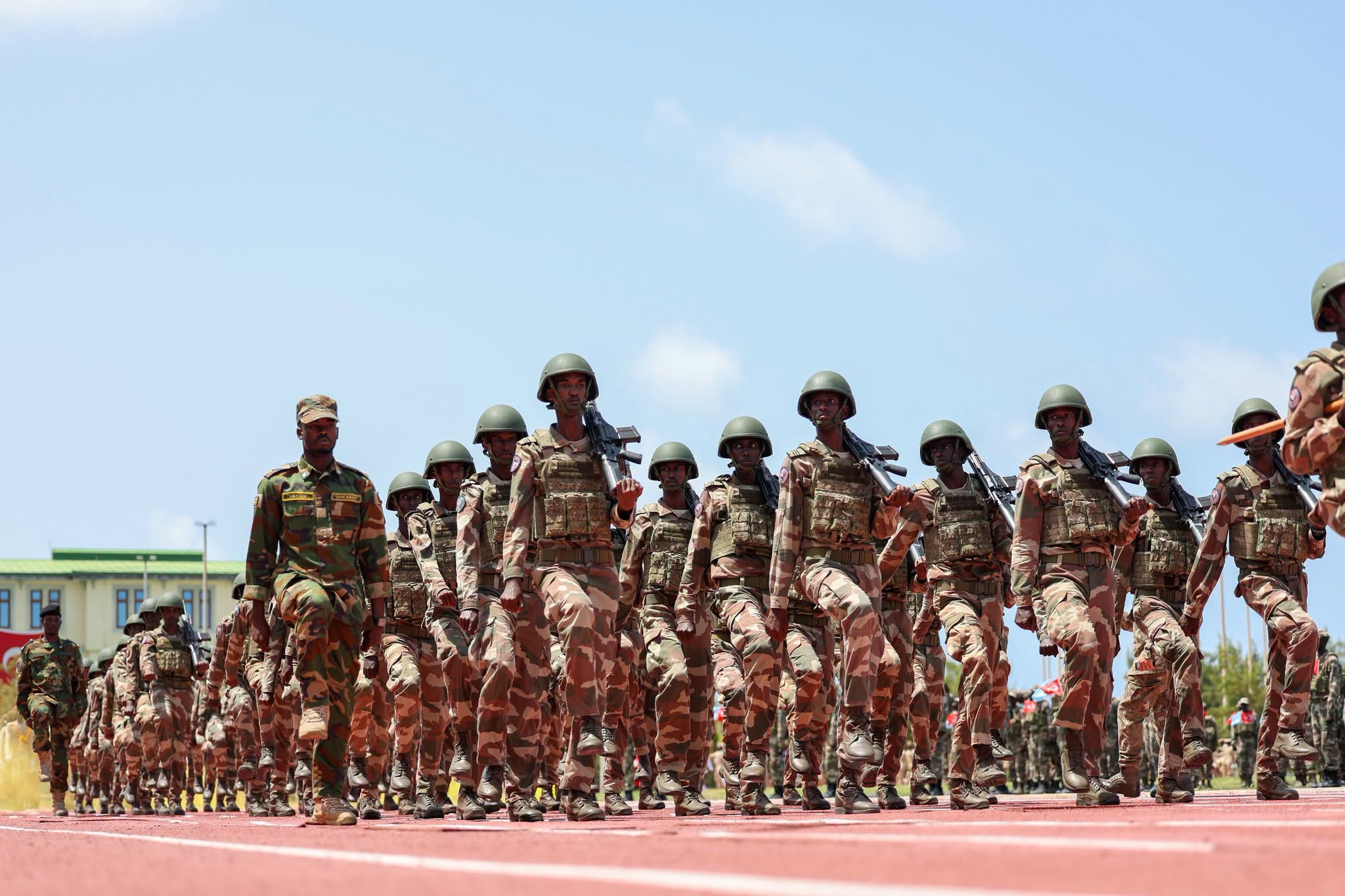
Dhusamareb (Somali Report) — Saudi Arabia is funding the training of more than 5,000 Somali soldiers based in Guri’el district in Somalia’s central Galgaduud region, as Riyadh expands its security role in the Horn of Africa.
A Saudi military delegation visited two training camps in Guri’el this week, where new Somali forces are undergoing instruction under a federal government program. The recruits are expected to join the Somali National Army after completing training.
The program includes nearly 2,000 young men recruited from Puntland, while the remaining trainees were drawn from other regions of Somalia, according to reports. The training is expected to last nine months and cover basic military skills, operational procedures and combat readiness.
Foreign military instructors from Romania, Ukraine, South Africa and Colombia are expected to take part in the training. Somali officials have not publicly explained in detail how the trainers were selected or what specific instruction they will provide.
The Saudi delegation’s visit comes months after Somalia and Saudi Arabia signed a defense and military cooperation agreement in Riyadh on Feb. 9, 2026. Somali Defense Minister Ahmed Moalim Fiqi signed the agreement with Saudi Defense Minister Prince Khalid bin Salman.
Officials said the agreement was intended to strengthen defense ties, expand military training and support cooperation in areas of mutual interest. Not all provisions of the agreement have been made public.
Somali Report · Newsletter
Your morning briefing on Somalia's biggest stories — politics, security, business, and the people shaping the region's future.
The training program in Guri’el appears to be one of the first major steps in implementing that cooperation. It also comes as Saudi Arabia seeks a broader security role in Somalia and the wider Horn of Africa, a region of growing strategic importance because of its proximity to the Red Sea, Gulf of Aden and Indian Ocean.
Guri’el has long been a politically and religiously sensitive district. The area has been influenced by Ahlu Sunna Waljama’a (ASWJ), a Sufi-aligned group that has played both security and political roles in central Somalia. Although ASWJ has been disarmed and integrated in part into Galmudug state and federal security structures, it continues to hold influence in parts of Guri’el and Galmudug.
Sheikh Mohamed Shakir Ali Hassan, a senior ASWJ figure, now leads the Tawfiq Political Party. The group’s historical presence in Guri’el adds a layer of local complexity to the new military training program.
Weeks ago, the United Nations and Somalia’s federal government removed Ahlu Sunna Waljama’a from the country’s list of groups accused of recruiting and using children in armed conflict. The decision followed a verification process by the U.N. Country Task Force on Monitoring and Reporting and Somalia’s security institutions, which found that ASWJ no longer met the criteria for inclusion on the watchlist.
Saudi Arabia officially follows the Hanbali-Wahhabi tradition, while ASWJ is rooted in Sufi religious networks. The two differ significantly in religious methodology, jurisprudence and political outlook, making Guri’el’s local religious landscape important to understanding the broader context of Saudi-backed training in the district.
Somalia has signed military training and support agreements in recent years with several countries, including Turkey, the United States, the United Arab Emirates, Egypt, Eritrea and Uganda. The growing number of foreign-backed training programs reflects both Somalia’s need to rebuild its armed forces and the rising competition among regional and global powers for influence in the country.
Somalia’s location at the crossroads of the Indian Ocean, the Red Sea and the Gulf of Aden makes it strategically important for countries seeking to protect trade routes, expand maritime influence and shape security developments in the Horn of Africa.
About the Author
Osman Hassan is a Senior Editor at the Somali Report based in Nairobi with over 15 years of experience in journalism. He has worked with local and international media outlets in Somalia and is an award-winning journalist. His reporting focuses on politics, security, and regional affairs in the Horn of Africa.
Somalia condemns Houthi attacks on Saudi Arabia, warns of regional security threat


