Somali President Hassan Sheikh Mohamud has accused the United Arab Emirates of interfering in Somalia's internal affairs, backing rival regional administrations and undermining the country's sovereignty, warning against foreign attempts to divide the nation.
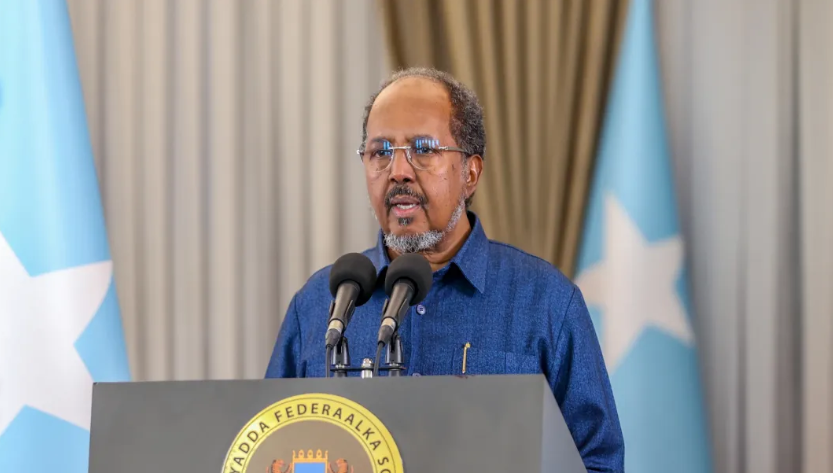 MOGADISHU (Somali Report) — Somali President Hassan Sheikh Mohamud has accused the United Arab Emirates of interfering in Somalia's internal affairs, undermining its sovereignty and supporting efforts to weaken the authority of the federal government.
In a strongly worded speech, Hassan warned that Somalia risked experiencing divisions similar to those in Libya and Yemen, where he accused the UAE of playing a destabilising role. He said Abu Dhabi had now turned its attention towards Somalia and Sudan.
The president urged Somalis to strengthen political unity and national institutions to prevent the country from falling into a similar crisis. He also said the UAE had continued actions aimed at weakening Somalia's central government, despite Mogadishu's decision to terminate agreements with Abu Dhabi about 10 months ago.
Hassan acknowledged the longstanding historical ties between the two countries, rooted in Islam, cultural relations and trade. He noted that thousands of Somalis had found employment, business opportunities and access to financial services in the UAE during decades of state collapse in Somalia.
But he said relations built on brotherhood had deteriorated because of what he described as Emirati interference in Somalia's domestic affairs.
"A brother does not burn your house. A brother does not buy your property without your knowledge. A brother does not divide your family," he said.
The president accused the UAE of establishing unauthorised military bases in Somalia and creating armed forces outside the command structure of the national military, describing the alleged activities as a threat to security institutions at a time when the country is fighting Al-Shabaab militants.
He also criticised agreements between the UAE and regional administrations concerning investments and the management of strategic ports in Berbera, Bosaso and Kismayo.
Hassan insisted that ports and other strategic infrastructure were national assets that could not be managed outside the framework of Somalia's constitution and federal authority.
The president also linked the UAE to Israel's recognition of Somaliland, accusing Abu Dhabi of playing a role in the move and failing to endorse Arab and Islamic statements condemning it.
He further alleged that the UAE had used Somali territory in January 2026 as a transit route for a Yemeni militia leader fleeing Yemen through the port city of Berbera, without the federal government's permission.
Somali Report · Newsletter
Your morning briefing on Somalia's biggest stories — politics, security, business, and the people shaping the region's future.
"Somali territory is not an illegal transit route, a commodity to be bought, or a place that can be entered whenever someone wishes," he said.
Hassan also accused Abu Dhabi of providing political and financial support to some Somali regional administrations to oppose the federal government, as well as strengthening ties with groups he said posed security threats to Somalia and the wider Horn of Africa.
He did not provide independently verifiable evidence to substantiate the allegations during the speech.
The president recalled that Somalia's Council of Ministers decided on January 12, 2026, to annul all agreements with the UAE covering security, defence and economic cooperation. The government also banned Emirati military and cargo aircraft from Somali airspace.
Addressing communities in Somaliland, Puntland and Jubaland, Hassan said they remained integral parts of the Somali nation and urged political disputes to be resolved through domestic dialogue rather than foreign intervention.
He called on young people to resist efforts to divide Somali society and urged the armed forces to defend the country's unity.
"Somalia is one. It has always been one, and it will remain one forever," he said.
In his closing remarks, Hassan distinguished between the Emirati people and their government's policies, saying Somalia remained open to relations based on equality, mutual respect and recognition of its territorial integrity.
But he warned that Mogadishu would not accept any action that undermined its sovereignty or national unity.
"Somalia today is not the Somalia of yesterday, which some considered weak. We are a nation with a constitution, a legitimate government and a people determined to defend their dignity, independence and unity," he said.
In January this year, Somalia has severed all agreements with the United Arab Emirates, annulling deals spanning key port operations, security cooperation and defence, citing “harmful actions” that undermine the country’s unity and sovereignty.
About the Author
Ahmed Omar is a senior journalist for Somali Report, based in Mogadishu. He has two decades of experience reporting on Somalia for international and local media. He covers politics, security, governance, business, trade, economic developments and regional affairs.
