Kenya’s High Court has awarded Somali lawyer Abdinoor Maalim Ismail KSh 6.9 million (US$53,400) after ruling that prosecutors violated his constitutional rights by pursuing terrorism charges linked to the 2019 DusitD2 attack without sufficient evidence.
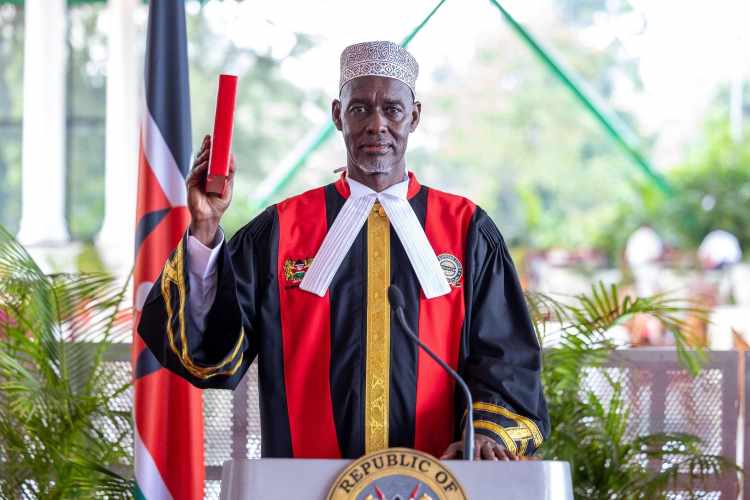 Kenyan Supreme Court Justice Mohamed Abdullahi Warsame during his swearing-in ceremony at State House, Nairobi, in May 2026.
NAIROBI (Somali Report) — Kenya’s High Court has awarded Somali lawyer Abdinoor Maalim Ismail KSh 6.9 million (approximately US$53,400) after ruling that prosecutors violated his constitutional rights by pursuing terrorism charges against him without sufficient evidence following the 2019 DusitD2 terrorist attack in Nairobi.
In a landmark judgment, Justice Patricia Mande found that the Office of the Director of Public Prosecutions (ODPP) abused its constitutional powers by prosecuting Abdinoor despite lacking adequate evidence to support the case.
The court awarded KSh 5 million (about US$38,700) in general damages for violating his constitutional rights and an additional KSh 1.9 million (about US$14,700) as special damages to reimburse legal expenses he incurred while defending himself. The ODPP was also ordered to pay the costs of the constitutional petition.
The case stems from investigations into the January 2019 terrorist attack on the DusitD2 hotel complex in Nairobi, in which gunmen linked to Al-Shabaab killed 21 people.
Abdinoor, an advocate and director of Seatech Limited, was arrested shortly after the attack and accused of facilitating terrorism financing through his company’s M-Pesa business and assisting the attackers.
He spent 39 days in custody before being formally charged and then fought the case in court for nearly three years.
In March 2022, the trial court acquitted him after finding that prosecutors had failed to establish a prima facie case requiring him to defend himself.
Justice Mande ruled that although Abdinoor had not proven that prosecutors acted with malice, the ODPP nevertheless violated Article 157(11) of Kenya’s Constitution by instituting criminal proceedings without an adequate factual foundation.
“The institution of criminal proceedings without a sufficient factual foundation violated Article 157(11) of the Constitution and amounted to an abuse of prosecutorial power,” the court ruled.
The judge further held that the prosecution infringed Abdinoor’s constitutional right to equal protection under the law, saying the decision to charge him failed to meet the constitutional standards required of public prosecutors.
Somali Report · Newsletter
Your morning briefing on Somalia's biggest stories — politics, security, business, and the people shaping the region's future.
The court, however, declined to hold the Inspector General of Police liable for Abdinoor’s prolonged detention, finding that his continued custody had been authorised through lawful court orders issued during the investigation.
According to court documents, the prosecution significantly disrupted Abdinoor’s personal and professional life, including delaying his admission to the Roll of Advocates despite eventually being cleared of all wrongdoing.
“The prolonged detention and extended criminal proceedings caused significant personal and professional prejudice to the petitioner,” Justice Mande observed.
The ruling is being viewed as an important reminder that anti-terrorism investigations must still comply with constitutional safeguards, even in cases involving national security.
Kenyan courts have repeatedly affirmed that prosecutors must demonstrate sufficient evidence before commencing criminal proceedings and that constitutional rights cannot be suspended merely because allegations relate to terrorism.
Following the judgment, Abdinoor welcomed the ruling, saying that while no financial award could compensate for the hardship he endured, he was grateful that the court had recognised the injustice he suffered.
Speaking to BBC Somali, he urged Somalis and other communities facing wrongful prosecution to pursue justice through the courts rather than lose faith in the legal system.
“Justice may take time, but the law belongs to everyone,” he said.
Legal analysts say the decision reinforces judicial oversight of prosecutorial powers and may influence future cases involving wrongful prosecution, unlawful detention and constitutional violations in Kenya’s criminal justice system.
The ruling also highlights the continuing balance Kenyan courts seek to maintain between protecting national security and safeguarding individual constitutional rights during terrorism investigations.
About the Author
Fatuma Taxadar Yusuf is the Editor-in-Chief of Somali Report. She was the first woman to serve as an editor and media managing director in Somalia’s Puntland State. Previously, she worked with the BBC World Service and other leading media organizations in Somalia. She also serves as Deputy Chairperson of the Somalia Media Council, an independent body that regulates media standards and professional conduct in Somalia.
Somalia's Supreme Court Upholds Galmudug Election Results as JSP Wins 67 Seats


