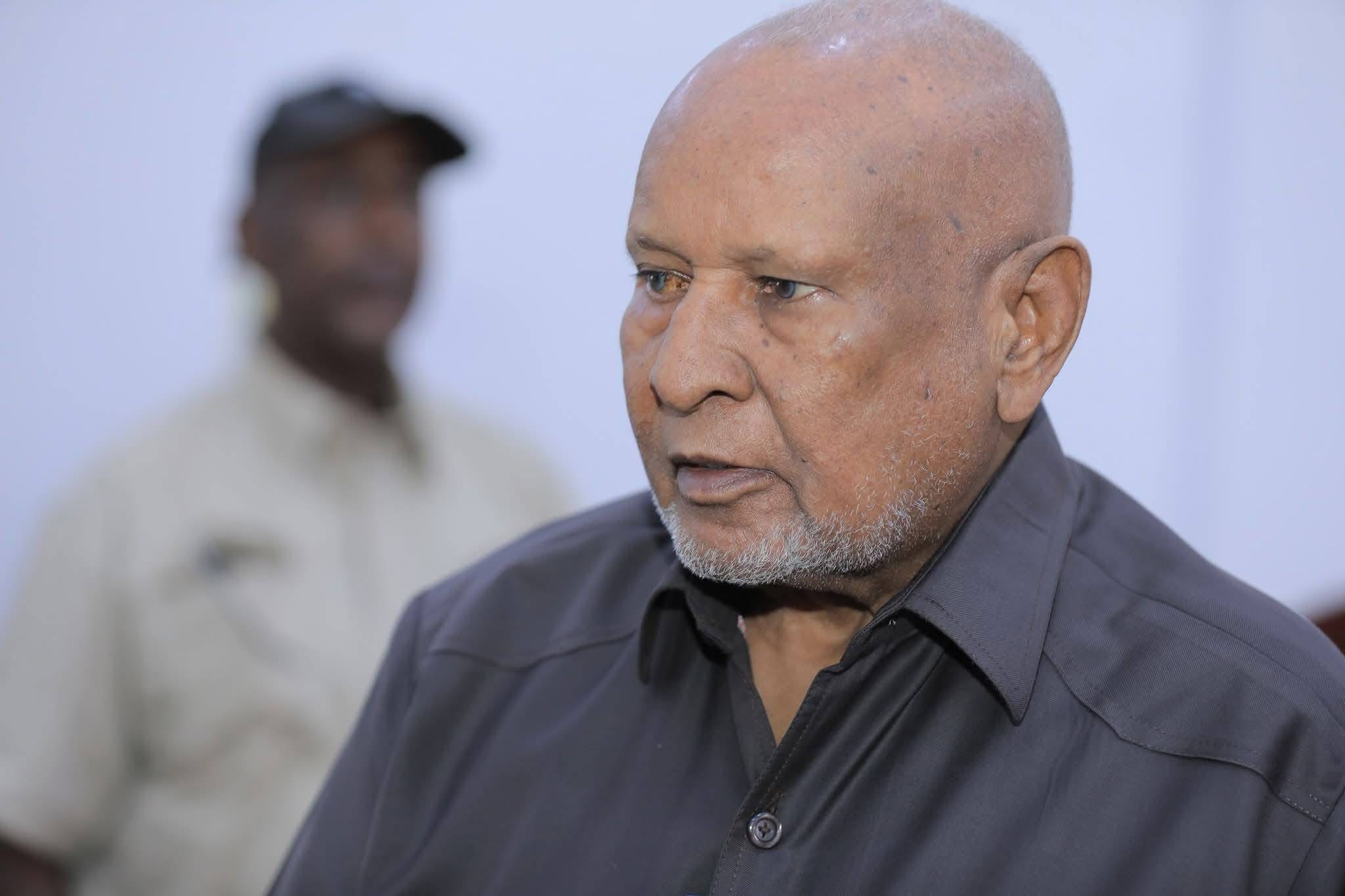
Saleebaan Maxamuud Aadan, one of Somaliland’s most influential political figures, has resigned as Speaker of the House of Elders after more than two decades in office, ending one of the longest parliamentary leadership tenures in the Horn of Africa.
 HARGEISA (Somali Report) —
Somaliland’s longest-serving parliamentary leader, Saleebaan Maxamuud Aadan, has resigned as Speaker of the House of Elders (Guurti), bringing to an end more than two decades at the helm of the influential upper chamber and closing one of the most significant chapters in Somaliland’s modern political history.
The 94-year-old veteran politician formally announced his resignation during an extraordinary session of the Guurti in Hargeisa on Sunday, telling lawmakers that advancing age and declining health had made it time to step aside after years of public service.
“I have worked for a long time, reached old age and now need to rest,” Saleebaan told members of the chamber.
Lawmakers unanimously accepted his resignation before electing veteran Guurti member Muse Haji Abdi Ducaale as the new Speaker.
The transition was uncontested after the two other candidates, Sahal Idle Dirir and Sultan Ismail Sultan Abdirahman, withdrew their candidacies before voting, allowing Ducaale to be elected by acclamation.
Saleebaan first became Speaker of the House of Elders in August 2004, following the death of his predecessor, Sheikh Ibrahim Sheikh Yusuf Sheikh Madar. Over the next 22 years, he worked alongside Somaliland’s last four presidents—Dahir Riyale Kahin, Ahmed Mohamed Mohamoud “Silanyo”, Muse Bihi Abdi and the current president, Abdirahman Mohamed Abdullahi “Irro”.
His tenure made him one of the longest-serving parliamentary leaders anywhere in Africa.
The House of Elders occupies a unique place in Somaliland’s political system. Made up of traditional clan elders, it serves as the upper chamber of parliament and plays a constitutional role in legislation, mediation and conflict resolution.
Somali Report · Newsletter
Your morning briefing on Somalia's biggest stories — politics, security, business, and the people shaping the region's future.
Throughout Somaliland’s political evolution, the Guurti has frequently acted as an intermediary during periods of political tension and electoral disputes.
Supporters credit Saleebaan with helping preserve Somaliland’s stability during several constitutional crises and difficult political transitions, arguing that his experience and influence within traditional leadership structures contributed to maintaining dialogue between rival political actors.
However, his leadership also attracted criticism.
Opposition parties, civil society groups and constitutional experts repeatedly accused the Guurti of extending the terms of successive governments and parliament beyond their original mandates. Critics also argued that the institution had increasingly drifted away from its constitutional role in reconciliation and oversight.
Despite the criticism, Saleebaan remained one of Somaliland’s most recognizable political figures.
Before Somaliland declared independence in 1991, he served in several senior positions under Somalia’s former government, including as deputy minister of education and later deputy minister of fisheries. Following Somaliland’s declaration of independence, he held several cabinet positions, including interior, education, foreign affairs and finance, before unsuccessfully contesting the presidency in 1997.
His resignation marks the end of more than three decades of continuous senior public service in Somaliland.
The leadership transition also comes at a time when Somaliland is seeking to strengthen state institutions while expanding its international engagement following growing diplomatic attention after its recent recognition by Israel.
With a new Speaker now leading the Guurti, attention is expected to shift toward how the upper chamber positions itself on constitutional reforms, political reconciliation and Somaliland’s evolving domestic and international agenda.
About the Author
Khadar Abdi is the Somaliland Correspondent for Somali Report. He covers politics, security, governance, business, trade, economic developments, and regional affairs across Somaliland.
Somalia condemns Houthi attacks on Saudi Arabia, warns of regional security threat


