Ethiopia's navy chief, Admiral Kindu Gezu, has warned that the country could pursue the recovery of its lost maritime access if diplomatic negotiations fail, raising fresh concerns over regional tensions in the Horn of Africa.
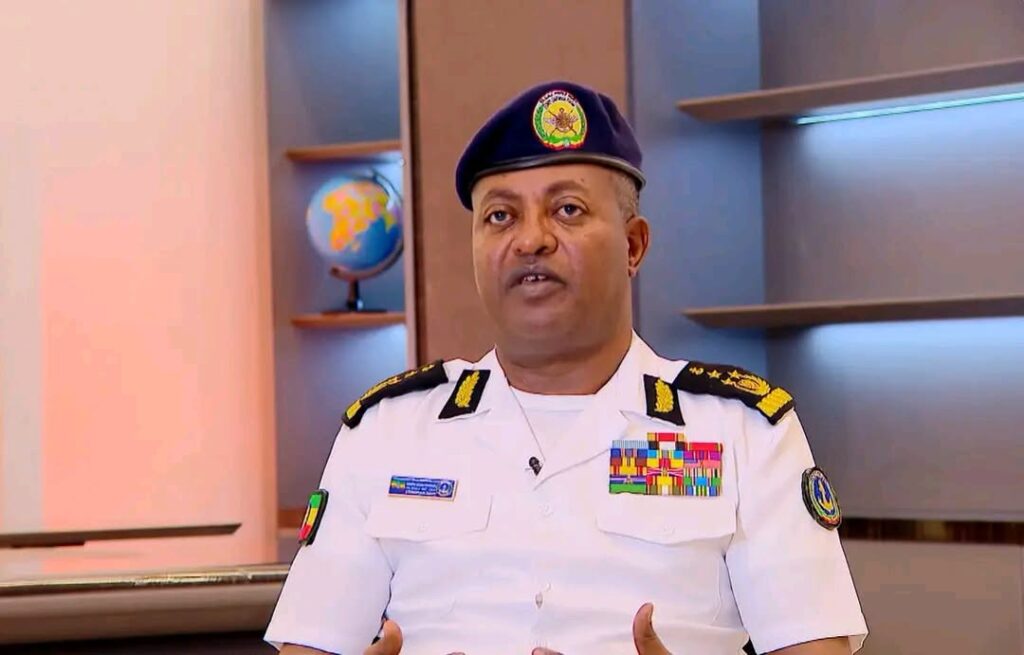 ADDIS ABABA (Somali Report) — Ethiopia's navy chief has warned that the country is prepared to pursue the recovery of what he described as its "unjustly lost" sea access if diplomatic efforts to secure a maritime outlet fail, while insisting that Addis Ababa has no intention of invading another country.
Admiral Kindu Gezu, commander of the Ethiopian Navy, said Ethiopia's demand for access to the sea was not driven by territorial expansion or plans to launch military aggression against its neighbours.
He said the government wanted to resolve the issue through international law and diplomatic negotiations, stressing that peaceful dialogue remained the preferred approach.
However, Gezu warned that Ethiopia would be prepared to reclaim what he described as its historical maritime access if negotiations failed to deliver a peaceful settlement.
"If we lose the sea access we are seeking through peaceful means..." he said, in remarks that underscored the growing importance of the issue in Ethiopia's regional policy.
The admiral's comments reflect the strategic priority Ethiopia has placed on securing reliable access to the sea, particularly after the country became landlocked following Eritrea's independence in 1993.
Ethiopia, Africa's second-most populous country, relies heavily on neighbouring states for access to international shipping routes. Most of its maritime trade currently passes through Djibouti, making access to the port a central component of its economic and national security planning.
Prime Minister Abiy Ahmed has repeatedly described access to the sea as an important national interest, arguing that a country of Ethiopia's size and economic ambitions should have dependable maritime access.
Somali Report · Newsletter
Your morning briefing on Somalia's biggest stories — politics, security, business, and the people shaping the region's future.
The issue has nevertheless raised concerns among neighbouring countries, particularly Somalia, which has strongly opposed any arrangement that could undermine its sovereignty and territorial integrity.
Tensions escalated in January 2024 when Ethiopia signed a controversial memorandum of understanding with Somaliland, the breakaway region of Somalia, seeking access to the Red Sea through its coastline in exchange for possible recognition of its independence.
Somalia rejected the agreement as a violation of its sovereignty, while the deal triggered a diplomatic crisis between Mogadishu and Addis Ababa.
The two countries later signed the Ankara Declaration in December 2024, under Turkish mediation, committing to respect each other's sovereignty and territorial integrity and to pursue commercial arrangements that would give Ethiopia reliable access to the sea under Somalia's sovereign authority.
The declaration offered a diplomatic framework for addressing the dispute, although questions surrounding its implementation and the nature of any future maritime agreement have remained important regional issues.
Gezu's latest remarks are likely to draw attention across the Horn of Africa, where access to ports, maritime routes and control of strategic waterways have become increasingly sensitive geopolitical issues.
Somalia has consistently maintained that any agreement involving access to its coastline must be negotiated with and approved by the federal government.
Ethiopia has not publicly abandoned its ambition to secure direct access to the sea, but its stated preference for negotiations has been central to efforts to prevent the dispute from escalating into a wider regional confrontation.
About the Author
Ahmed Omar is a senior journalist for Somali Report, based in Mogadishu. He has two decades of experience reporting on Somalia for international and local media. He covers politics, security, governance, business, trade, economic developments and regional affairs.
