Somali President Hassan Sheikh Mohamud says Mogadishu maintains good relations with Ethiopia and Eritrea and will not take sides in disputes between the two neighbouring countries.
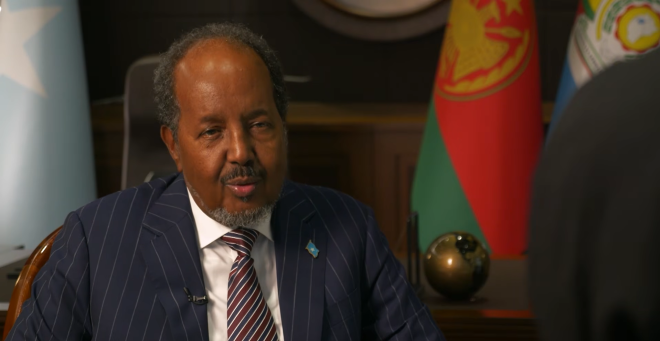 MOGADISHU (Somali Report) — Somali President Hassan Sheikh Mohamud has said his country maintains good relations with both Ethiopia and Eritrea, stressing that Mogadishu does not intend to take sides in disputes between the neighbouring states.
In an interview with Sky News, Mohamud said Somalia was not involved in the disagreements between Addis Ababa and Asmara and had no intention of intervening in their bilateral affairs.
“We have good relations with Ethiopia, and we also have good relations with Eritrea. Whatever happens between the two countries is their own affair. We are not part of it, and there are no disputes that we want to interfere in,” he said.
The comments underline Somalia’s stated diplomatic position as tensions between Ethiopia and Eritrea continue to draw attention across the Horn of Africa, a region where political and security disputes have often strained relations between neighbouring countries.
Mohamud said his government’s foreign policy was based on promoting understanding, cooperation and peace, adding that Somalia wanted to maintain constructive relations with countries in the region and beyond.
He described the country’s guiding principle as Somalia being at peace with itself and with the wider world.
The president’s remarks come amid renewed diplomatic sensitivities in the Horn of Africa, particularly over relations between Ethiopia and Eritrea, whose history includes a devastating border war from 1998 to 2000.
Somali Report · Newsletter
Your morning briefing on Somalia's biggest stories — politics, security, business, and the people shaping the region's future.
The two countries signed a peace agreement in 2018 after years of hostility, but their relationship has faced fresh strains in recent years. Ethiopia’s pursuit of access to the sea has also heightened regional concerns, particularly in neighbouring countries.
Somalia has itself been at the centre of regional diplomatic tensions, notably after Ethiopia signed a memorandum of understanding with Somaliland in January 2024. The agreement, which Mogadishu strongly opposed, was intended to give landlocked Ethiopia access to the sea through Somaliland.
Somalia described the move as a violation of its sovereignty and territorial integrity, leading to a sharp deterioration in relations between Mogadishu and Addis Ababa. The two sides later reached an understanding under a Turkish-brokered process in Ankara in December 2024, agreeing to pursue commercial arrangements that would give Ethiopia access to the sea under Somalia’s sovereign authority.
Against that backdrop, Mohamud’s latest comments appear aimed at presenting Somalia as seeking stable relations with both Ethiopia and Eritrea rather than becoming involved in their competing interests.
The Horn of Africa remains strategically important because of its proximity to the Red Sea and the Gulf of Aden, key international shipping routes. Regional rivalries, maritime access and security cooperation have increasingly shaped diplomatic relations among countries in the area.
Somalia has repeatedly called for dialogue and regional cooperation, saying stability depends on respect for sovereignty, territorial integrity and the peaceful resolution of disputes.
Mohamud’s remarks signal that Mogadishu wants to keep its diplomatic channels open with both Addis Ababa and Asmara while avoiding direct involvement in disagreements between them.
About the Author
Ahmed Omar is a senior journalist for Somali Report, based in Mogadishu. He has two decades of experience reporting on Somalia for international and local media. He covers politics, security, governance, business, trade, economic developments and regional affairs.
