Somalia's State Minister for Foreign Affairs Ali Mohamed Omar has declined to criticise US President Donald Trump over his derogatory remarks about Somalis, saying Trump is the legitimate leader elected by American voters.
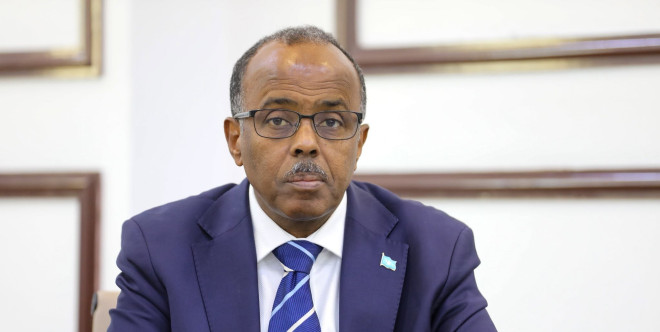 MOGADISHU (Somali Report) — Somalia's State Minister for Foreign Affairs, Ali Mohamed Omar, known as Ali Balcad, has declined to criticise US President Donald Trump over his controversial remarks about Somalis and the Somali community living in the United States.
In an interview with Al Jazeera English's Talk to Al Jazeera, broadcast on November 16, 2026, Balcad was asked whether he and the Somali community had been offended by Trump's repeated derogatory comments about Somalis and Somalia.
The interviewer reminded the minister that Trump had previously described Somalis living in the United States as "garbage" and suggested they contributed nothing to the country. The US president has also used disparaging language to describe Somalia, portraying it as a dirty, ugly and crime-ridden country.
Asked whether such remarks had caused offence, Balcad avoided directly addressing Trump's comments, instead emphasising his own American citizenship and the US president's democratic mandate.
"First of all, I am also an American citizen. President Trump was elected by American citizens, and therefore he is the legitimate president of the United States. So I will not respond to the remarks he has made," Balcad said.
His response came amid renewed scrutiny of Trump's rhetoric towards Somali immigrants and the wider Somali-American community, which has faced repeated criticism from the US president.
The interview also examined Somalia's political and security situation, more than three decades after the collapse of the country's central government in 1991, and its efforts to rebuild state institutions and restore stability.
Balcad said Somalia had made progress in improving security and rebuilding government institutions, crediting international partners with playing an important role in the country's recovery.
Somali Report · Newsletter
Your morning briefing on Somalia's biggest stories — politics, security, business, and the people shaping the region's future.
He also discussed the end of the United Nations political mission in Somalia, which closed in October 2026 following a request from the Somali government.
The minister portrayed the closure as a sign of the government's determination to assume greater responsibility for managing the country's domestic affairs and advancing its political priorities.
However, Somalia continues to face significant security challenges, particularly its prolonged fight against Al-Shabaab, an Al-Qaeda-linked militant group that has waged an insurgency against the federal government for more than 15 years.
African Union forces remain deployed in the country to support Somali security forces in operations against the militants, as concerns persist over the sustainability of international financial support for the mission.
The interview also touched on concerns about possible reductions in US financial assistance to the African Union-led security operation, at a time when Somali forces are still working to strengthen their capacity to take over security responsibilities.
Balcad acknowledged that Somalia continued to face security, political and economic difficulties but maintained that the country was more stable today than it had been in previous years.
He expressed hope that international partners would maintain their financial and political support, arguing that continued assistance remained important as Somalia sought to consolidate its progress and strengthen its institutions.
The interview offered an overview of the government's efforts to present Somalia as a country gradually emerging from decades of conflict, while still heavily dependent on international cooperation to address its security and development challenges.
About the Author
Ahmed Omar is a senior journalist for Somali Report, based in Mogadishu. He has two decades of experience reporting on Somalia for international and local media. He covers politics, security, governance, business, trade, economic developments and regional affairs.
