Somalia and China have held talks on the future of the African Union mission (AUSSOM), defence cooperation and plans to transfer greater security responsibilities to Somali forces.
 MOGADISHU (Somali Report) — Somalia and China have discussed the future of the African Union mission in the country and plans for a security transition, as Mogadishu seeks to strengthen its armed forces and gradually assume greater responsibility for national security.
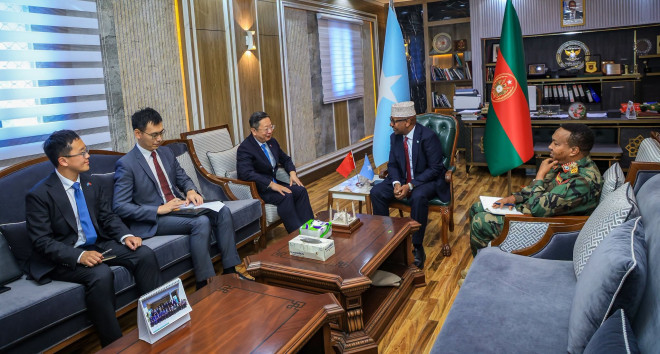
The discussions took place on Monday during a meeting in Mogadishu between Somali Defence Minister Ahmed Moallim Fiqi and China's ambassador to Somalia, Wang Yu, according to information released by the Somali government.
The two officials reviewed Somalia's defence situation, military operations against Al-Shabaab militants and the future of the African Union Support and Stabilization Mission in Somalia (AUSSOM), which provides support to Somali forces fighting the Islamist insurgency.
Fiqi briefed the Chinese envoy on the government's security priorities, highlighting efforts to improve the capabilities of the Somali National Army and strengthen its ability to independently defend the country.
He stressed the importance of continued international cooperation as Somalia prepares to take on a greater role in managing its security, particularly amid changes affecting the African Union mission and the broader withdrawal of foreign military forces.
The talks come as Somalia faces the challenge of maintaining security gains against Al-Shabaab while preparing its forces to take over responsibilities currently supported by international partners.
The group, which has waged an insurgency against the Somali government for more than 15 years, continues to carry out attacks against military positions, government institutions and civilian targets, despite repeated military offensives by Somali forces and their allies.
Fiqi also thanked Beijing for its continued support, particularly its position backing Somalia's sovereignty, national unity and territorial integrity.
He said the federal government remained committed to protecting the country's national interests amid security and political concerns involving foreign interference.
Somali Report · Newsletter
Your morning briefing on Somalia's biggest stories — politics, security, business, and the people shaping the region's future.
China has repeatedly reaffirmed its support for Somalia's sovereignty and territorial integrity, a position welcomed by Mogadishu as it seeks to strengthen diplomatic relations and defend its internationally recognised borders.
The issue of territorial integrity has become increasingly important for Somalia's federal government, which has been seeking support from international partners on matters affecting its national unity and regional stability.
Somalia has also been working to deepen defence and security cooperation with international allies as it seeks to build a more capable national army and reduce its dependence on foreign military assistance.
AUSSOM replaced the African Union Transition Mission in Somalia (ATMIS) in January 2025, following a decision to establish a new mission to support the country's security priorities.
Its mandate includes assisting Somali forces in operations against Al-Shabaab, supporting stabilisation efforts and strengthening the capacity of national security institutions to eventually assume full responsibility for the country's defence.
The mission operates amid continuing concerns about the sustainability of Somalia's security transition, particularly the availability of sufficient troops, equipment, funding and logistical support for national forces.
The gradual transfer of security responsibilities to Somali forces is considered a critical part of the country's broader efforts to stabilise areas recovered from Al-Shabaab and expand government control.
The meeting was also attended by Brigadier General Mohamed Ali Barise, an assistant to the chief of the Somali National Army, and officials from the Chinese embassy in Mogadishu.
No specific agreements or new military commitments were announced following the talks.
About the Author
Ahmed Omar is a senior journalist for Somali Report, based in Mogadishu. He has two decades of experience reporting on Somalia for international and local media. He covers politics, security, governance, business, trade, economic developments and regional affairs.
