Somaliland President Abdirahman Mohamed Abdullahi (Cirro) has urged the United Kingdom to play a more active role in supporting Somaliland’s recognition, saying the territory’s decades-long statehood campaign is irreversible while reaffirming closer ties with Britain.
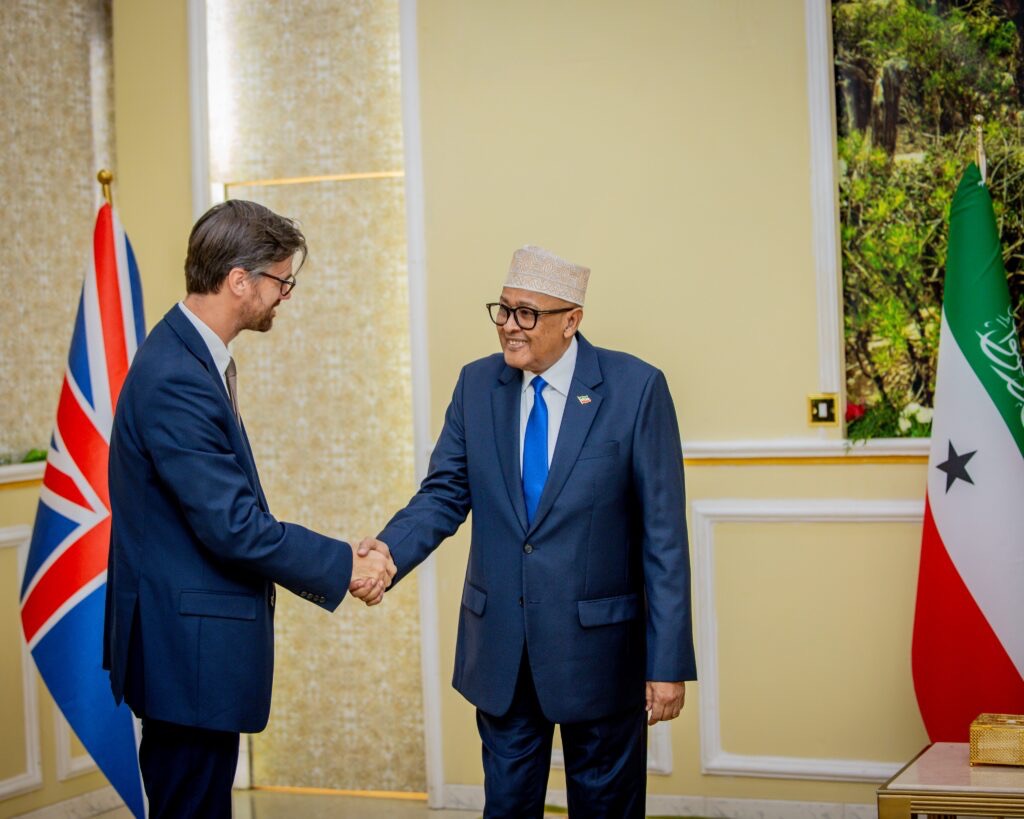 HARGEISA (Somali Report) — Somaliland President Abdirahman Mohamed Abdullahi (Cirro) has urged the United Kingdom to play a more active role in supporting Somaliland’s bid for international recognition, declaring that the territory’s decades-long quest for statehood is now “irreversible” and founded on legal rights, historical legitimacy, and the democratic will of its people.
The appeal came during a high-level meeting in Hargeisa with the British Ambassador to Somalia, Charles King, and Louise Hancock, head of the UK Office in Somaliland, according to a statement issued by the Somaliland presidency.
President Cirro said Somaliland’s recognition campaign could no longer be reversed, arguing that its claim to statehood is based on its colonial-era borders, its brief period of internationally recognized independence in June 1960, and more than three decades of self-governance after declaring independence from Somalia in 1991.
“The process of seeking recognition is irreversible,” the presidency quoted Cirro as telling the British delegation.
The Somaliland leader called on London to take what he described as a constructive role in advancing Somaliland’s international recognition, arguing that formal recognition would contribute to long-term peace, stability, and economic development across the Horn of Africa.
During the meeting, Cirro praised the United Kingdom as one of Somaliland’s longest-standing international partners, highlighting decades of cooperation in security, governance, institution-building, and development.
He said Somaliland hopes to deepen collaboration with Britain in areas including water management, climate resilience, renewable energy, education, healthcare, trade, investment, democratic governance, and public sector reform.
“The United Kingdom has remained a strategic partner for Somaliland for many years,” the statement said, adding that the government remains committed to strengthening bilateral relations.
Cirro also underscored the historical ties between Somaliland and Britain, noting that the territory was administered as the British Somaliland Protectorate before gaining independence on 26 June 1960.
The meeting follows President Cirro’s recent diplomatic outreach, including his visit to Israel after the country formally recognized Somaliland, a move that sharply increased regional tensions and drew strong condemnation from Somalia’s federal government.
Somali Report · Newsletter
Your morning briefing on Somalia's biggest stories — politics, security, business, and the people shaping the region's future.
According to the Somaliland presidency, Ambassador Charles King praised Somaliland’s record of stability, democratic governance, peaceful elections, and institution-building, describing it as a positive example in a region often affected by conflict and political instability.
King also reaffirmed Britain’s commitment to maintaining close engagement with Somaliland and continuing support for its development priorities.
However, despite maintaining extensive relations with Somaliland authorities, the United Kingdom has not changed its long-standing policy on Somaliland’s political status.
London continues to recognize Somalia’s sovereignty and territorial integrity while maintaining practical cooperation with Somaliland through its diplomatic office in Hargeisa.
Successive British governments have consistently maintained that Somaliland’s future status should be resolved through dialogue between Mogadishu and Hargeisa rather than through unilateral international recognition.
Political analysts say President Cirro’s latest appeal is unlikely to trigger an immediate shift in British policy but reflects Somaliland’s broader diplomatic strategy of engaging influential Western governments as geopolitical competition in the Horn of Africa intensifies.
Supporters of Somaliland’s recognition campaign argue that the territory has met many of the practical criteria for statehood, pointing to regular elections, functioning democratic institutions, relative security, and peaceful transfers of power over the past three decades.
Somalia’s federal government, however, maintains that Somaliland remains an integral part of Somalia and insists that any questions surrounding its future must be resolved through negotiations rather than external recognition.
Formal talks between Mogadishu and Hargeisa began in 2012 with international backing but have repeatedly stalled over disagreements on sovereignty, constitutional arrangements, and implementation of previous agreements.
As Somaliland continues expanding its diplomatic outreach, President Cirro’s latest message to Britain signals that international recognition remains at the center of his administration’s foreign policy, even as major powers continue balancing practical engagement with Somaliland against their formal support for Somalia’s territorial integrity.
About the Author
Khadar Abdi is the Somaliland Correspondent for Somali Report. He covers politics, security, governance, business, trade, economic developments, and regional affairs across Somaliland.
Labour’s Newest MP Sagal Abdi-Wali Sworn Into House of Commons


