Somalia has condemned the arrival of an Israeli ambassador in Hargeisa and plans to establish an embassy in Somaliland, calling the moves violations of its sovereignty and territorial integrity.
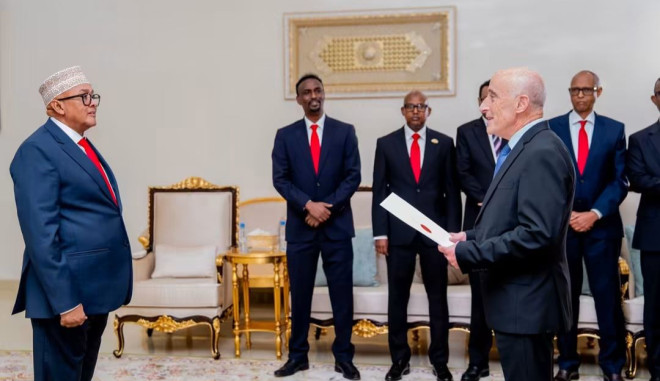 MOGADISHU (Somali Report) — Somalia's federal government has strongly condemned the arrival of Israel's ambassador to Hargeisa and the laying of a foundation stone for a building described as an embassy in the breakaway region of Somaliland, calling the moves violations of the country's sovereignty and territorial integrity.
In a statement issued on November 3, 2026, the Ministry of Foreign Affairs and International Cooperation said the actions had been taken without the consent of the Federal Government of Somalia and had no legal validity or effect.
The ministry reiterated that Hargeisa and the northwestern region remain an integral part of the Federal Republic of Somalia, rejecting any unilateral steps that could imply recognition of Somaliland as an independent state.
It said the establishment of diplomatic relations and the opening of permanent diplomatic missions require the consent of the sovereign state concerned, citing the Vienna Convention on Diplomatic Relations.
"Unilateral actions cannot override this requirement or alter the status of Somali territory," the ministry said.
The latest developments, Mogadishu said, further reinforce Israel's recognition of Somaliland, announced in December 2025, a move previously rejected by the African Union, the Intergovernmental Authority on Development (IGAD), the Arab League and the Organisation of Islamic Cooperation.
Somalia also expressed concern over the potential security implications of the developments, particularly amid heightened sensitivities in the Red Sea and Gulf of Aden.
Somali Report · Newsletter
Your morning briefing on Somalia's biggest stories — politics, security, business, and the people shaping the region's future.
The ministry warned that actions encouraging territorial fragmentation and disregarding internationally recognised borders risk aggravating tensions in an already strategically important region.
The Red Sea and Gulf of Aden are critical maritime corridors connecting the Indian Ocean to the Mediterranean through the Suez Canal. Their strategic importance has made regional stability a concern for countries across Africa and the Middle East.
Somalia called on Israel to immediately reverse the measures and urged governments and international organisations to reject the actions and refrain from any steps that could give them legitimacy.
The government said it reserved the right to pursue appropriate diplomatic, political and legal measures, in accordance with international law, to defend the country's sovereignty, unity and territorial integrity.
The ministry concluded by calling for respect for Somalia's sovereignty and internationally recognised borders, stressing that the unity of the Somali people was not open to negotiation.
The dispute comes amid continuing diplomatic tensions over Somaliland's political status. The region declared independence from Somalia in 1991 and has operated with its own administration for more than three decades, although its claim to statehood has not received broad international recognition.
About the Author
Ahmed Omar is a senior journalist for Somali Report, based in Mogadishu. He has two decades of experience reporting on Somalia for international and local media. He covers politics, security, governance, business, trade, economic developments and regional affairs.
