Somalia faces mounting security challenges as African Union forces draw down, political divisions deepen and al-Shabaab adapts to a changing regional order. An account of a confidential national security assessment raises a difficult question: can the Somali army afford to take over the country’s security responsibilities?
 MOGADISHU (Somali Report) —There’s a profound and palpable cynicism in Somalia’s national political discourse, one that borders with an outright nihilism. In fact, its not even new discourse. It has been taking deep hold and increasingly become a pervasive across the political identities.
Like every Somali, I asked wether this is a manufactured political narrative or something that’s born out of the cyclical political stalemate, or its part of the long simmering feeling that the state-building process is not moving at pace that can deliver for the ordinary Somali citizen, or its just the mental preparation for the withdrawal of the African Union troops which has become a permanent feature within the national security fabric, and spent the country over two decades or all the above.
There’s a fervent Kabul-style scenario that lurks in almost every political conversation.
Animated by this perception, I went to see a friend of mine who’s was senior government official and well placed into the national security briefings — and probably one the most knowledgable political operator in the country.
I asked him one question: Are we on the verge of national security collapse?
He pulled out his laptop and connected to big-wide screen TV. He opened up an internal national security memo with three big bullet points, each describing the overall national security assessment. The troop withdrawal and the geopolitical entanglement identified as the most existential threat facing the country, with the current political fragmentation in the country relegated to secondary column.
I asked him — in somewhat perplexing tone, why is that, after two 20 years of outsourcing our national security, relying on external troops, and we are yet unable to build a national, professional and coherent army capable to defend or at least fill in the vacuum left AU troops?
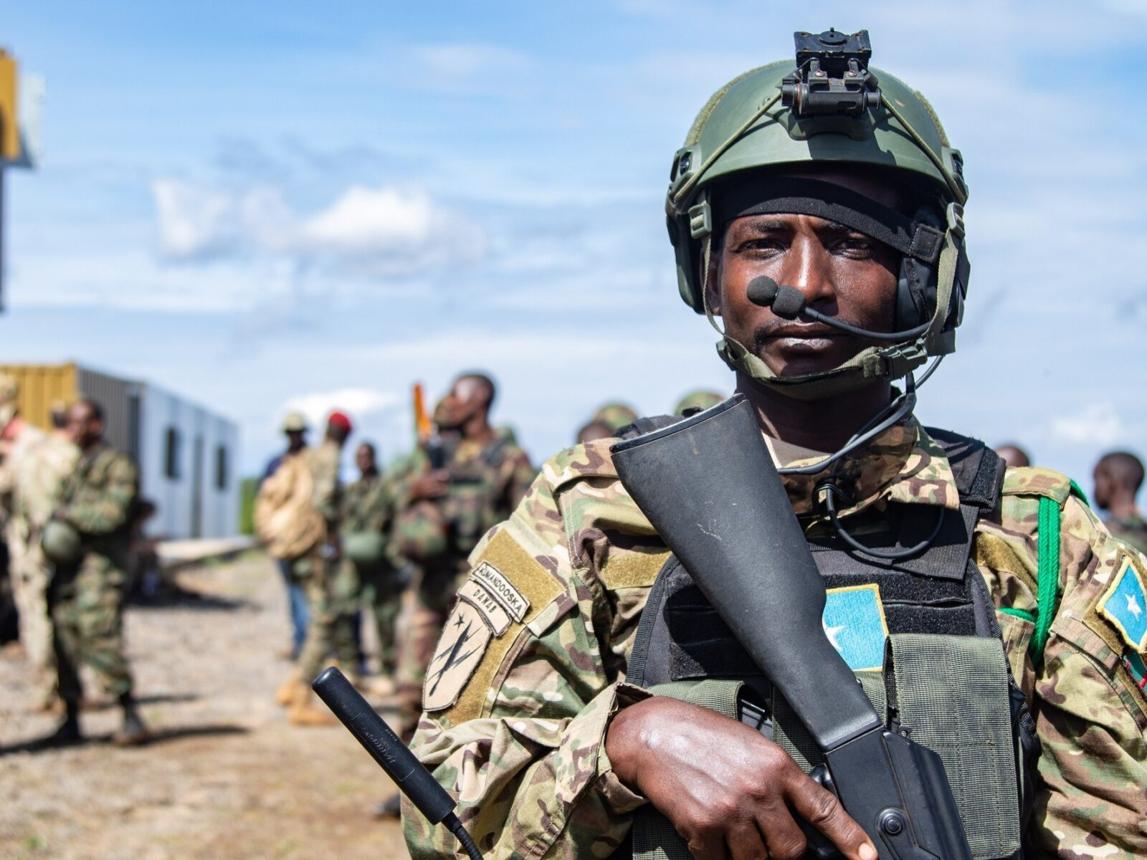
His answer was chilling and somewhat speaks to the broader pessimism narrative. He said we still need foreign peacekeeping troops for another decade, if not more, until we build a national army. Our dependency on foreign troops have become almost like opium and created superficial army that’s difficult to maintain in the modern war of attrition and the battlefield command. He then pulled up a second chart. If the first had outlined the country’s broader security vulnerabilities, the second was considerably more sobering. It offered an assessment of the Somali National Army’s capacity to assume the security responsibilities that would eventually be left behind by the African Union mission. The picture was far from reassuring. The army’s combat-ready capacity appeared limited, its resources woefully inadequate, and its existing forces already stretched beyond what they could sustain. In other words, his argument of having peacekeeping troops in the country for extended period is partially predicated based on this assessment — that the combat-readiness of to fill in the FOBs is very limited, hence, the the country was already preparing to transfer an enormous security burden to an army that was barely ready to assume — or fill in the role.
We have digressed briefly to American midterm elections. As we watched the results coming thick and fast, he said do you know the central theme for this midterm’s election in US? I said its affordability.
He said loudly YES! Then I asked what’s the corollary here?
Somali Report · Newsletter
Your morning briefing on Somalia's biggest stories — politics, security, business, and the people shaping the region's future.
He said we’ve affordability issue in our own national army. By which I mean, if we cant own the economics cost of the war — which he estimates nearly a billion dollar, its unlikely to build a sovereign, capable national army.
He went on further: Even if we win on the political argument, there remains a fundamental question of security-affordability. For more than two decades, the country’s entire security architecture was built on external investment. We have essentially mortgaged our national security. Much of that support is now either being withdrawn, reduced or permanently cut. What is even more problematic is the global order — for which Somalia was great beneficiary, has not only collapsed, but became a ruthless system in which weak states — like Somalia, pays the obscene price. The central question is, he said, whether we can afford an army that’s capable enough to confront with an adversary that has metastasized into something more complex: an terror organization that’s waging unconventional violence and yet exploits the geopolitical shift dynamics. The nature of al-Shabaab, as we use to know it, have dramatically shifted. They’re opportunistic, waiting to align to the moment.
I asked him whether he means that al-Shabaab has morphed into a political outfit, abandoned its jihadist insurgency, and if they’re entlangled into the regional proxies?
His answer was unequivocal: We have tendency to misread Al-Shabaab. They’re no longer simply an insurgent movement seeking to overthrow the Somali government; it is increasingly operating as an armed political actor, exploiting elite rivalries, institutional decay and the wider disorder reshaping the region. It banks on Afghan lesson: an insurgency does not necessarily have to defeat a state militarily, it only needs to wait, prolong the attrition war until you hollow it out from within.
Corruption, greed, misgovernance and internal power contestation among the elite would do half of the job and that, in turn, will erode the public confidence and, eventually, collapse the state on its weight. He asked me to remind that famous Afghan saying. I said are you referring: The Taliban have the time, Americans have the watch?
Yes, Al-Shabaab has always understood that time could be on its side, and that its interests might eventually converge with the frustrations of a disillusioned local people. Now, as geopolitical competition intensifies around the Red Sea and the Bab el-Mandeb, the group is also seeking to exploit a changing regional order, cultivating relationships with actors whose interests may temporarily align with its own. The danger, therefore, is not just that al-Shabaab can fight the Somali state; it is that it is positioning itself to exploit the political failures of that state and the geopolitical disorder and its cascading impact.
Then I challenged him: All the problems you illustrated are the symptoms, not the root causes — which’s inherently the political compact — and which you identified as secondary, not urgent problem in your memo. Why?
— Abdihakim Ainte is a Somali writer and political analyst specialising in governance, security and political developments in Somalia. He is co-founder of iRise Hub, a Mogadishu-based innovation and technology hub.
X: @AbdihakimAinte
