Sacked Supreme Court chairman Baashe Yusuf Ahmed says he is unsafe in Mogadishu, rejects President Hassan Sheikh Mohamud’s decision to remove him and demands the withdrawal of troops deployed at the court.
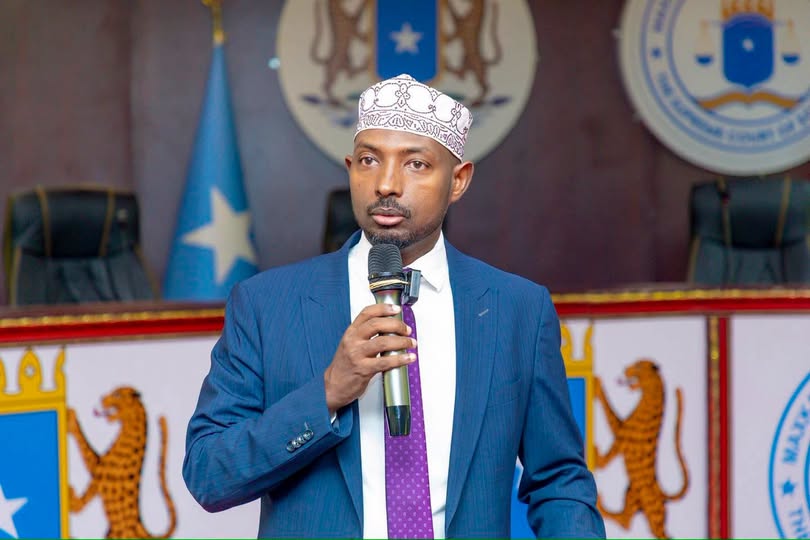
Baashe accused the president of interfering in the judiciary and using state power in ways he said violated the law, escalating a dispute over control of the country's highest judicial institution.
“I am not safe in the capital of my country,” Baashe said at a news conference in Mogadishu, according to Radio Risaala.
He said a large number of security personnel had been deployed to the Supreme Court premises, creating an atmosphere of fear and threatening his personal safety.
“I am not defending a position; I am defending the law. The president must remove the 300 soldiers he has deployed around the Supreme Court,” he said, according to local broadcaster Shabelle.
The number of troops cited by Baashe could not be independently verified.
He insisted that his objection was not about retaining his position but about protecting the rule of law and judicial independence.
Baashe also rejected allegations concerning alleged links between the Supreme Court and foreign countries, saying portraying the institution as serving another country's interests undermined Somalia's statehood.
He accused those behind the allegations of targeting and intimidating the judiciary.
The former chief further urged Mohamud to accept a Supreme Court ruling issued on November 5 concerning the constitutional terms of federal institutions.
He called on the president to act in the national interest, pursue political consultation and fulfil his responsibility to unite Somalis and safeguard the country's territorial integrity.
Dispute over dismissal
Mohamud dismissed Baashe on November 4 and appointed lawyer Ibrahim Idle Suleiman as his replacement.
Somali Report · Newsletter
Your morning briefing on Somalia's biggest stories — politics, security, business, and the people shaping the region's future.
The presidency justified the move by citing complaints from judges, judicial employees and legal professionals over transparency and fairness in the administration of justice.
Mohamud said sweeping reforms were needed in the judiciary to ensure that citizens could access credible and impartial justice.
But the Supreme Court rejected Baashe's removal the following day, arguing that the president had no authority to dismiss its chairman unilaterally.
The court described the move as an attempt to interfere with a constitutional case already before it, involving amendments to the constitution and the terms of federal institutions.
In its November 5 ruling, the court said the constitutional mandates of federal institutions had expired and called for elections to be held within 90 days.
The Attorney General's Office rejected the ruling on November 6, arguing that it lacked a legal basis.
It also said the court had failed to first resolve the government's objections concerning its jurisdiction to hear the case and the procedures followed.
The dispute deepened on Saturday when Mohamud attended the swearing-in ceremony of Suleiman as the new Supreme Court chairman, despite Baashe's continued rejection of his dismissal.
The president urged the incoming chairman to uphold the law, protect judicial independence and ensure equal access to justice.
The ceremony was attended by Prime Minister Hamza Abdi Barre, the speaker of the House of the People, the first deputy speaker of the Senate and the justice and constitutional affairs minister.
The standoff has added to tensions over the interpretation of Somalia's constitutional framework, the authority of federal institutions and the independence of the judiciary.
About the Author
Ahmed Omar is a senior journalist for Somali Report, based in Mogadishu. He has two decades of experience reporting on Somalia for international and local media. He covers politics, security, governance, business, trade, economic developments and regional affairs.
