Djibouti has hosted a multinational military exercise involving the US, France, Japan, Italy and Spain, underscoring its growing role in regional security as China maintains a major military base nearby.
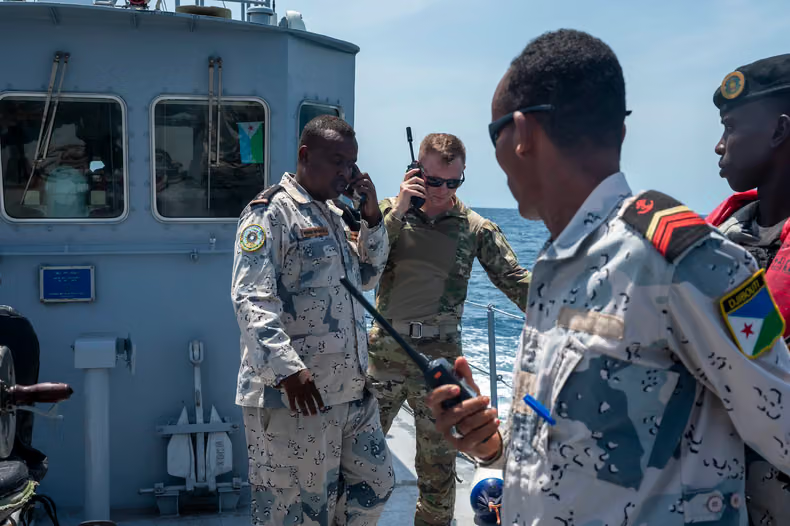 DJIBOUTI CITY (Somali Report) — Djibouti has hosted a multinational military exercise involving the United States, France, Japan, Italy and Spain, bringing together five international partners in a country that has become one of the world’s most important centres for foreign military operations.
The exercise, known as Bull Shark, focused on crisis response, personnel recovery and security operations across air, land and maritime environments, according to the US Africa Command (AFRICOM), which announced the participation on November 8.
China was notably absent from the exercise, despite maintaining its only officially acknowledged overseas military base in Djibouti, just a few miles from the US military installation at Camp Lemonnier.
The absence highlights the increasingly complex military landscape in the Horn of Africa, where global powers operate in close proximity while competing for influence over strategic maritime routes and regional security priorities.
AFRICOM said the exercise was designed to improve coordination among participating forces and strengthen their ability to respond to potential emergencies. By integrating operations across different military domains, the participating countries sought to improve cooperation and readiness in a region facing persistent security challenges.
For Djibouti, hosting the exercise reinforces its position as a major international military hub and a key partner in regional security operations.
China established its military base in Djibouti in 2017, marking a significant expansion of Beijing’s overseas military presence. The facility is located close to Camp Lemonnier, the United States’ principal military installation in Africa.
The proximity of the two bases has attracted considerable attention in Washington. The US Congressional Research Service has described Djibouti as an important front in the broader strategic competition between the United States and China.
Somali Report · Newsletter
Your morning briefing on Somalia's biggest stories — politics, security, business, and the people shaping the region's future.
That competition has taken on added significance as Beijing continues to develop its military and technological capabilities. A September 2026 assessment by the Center for Strategic and International Studies reported upgrades to China's Djibouti facility, including communications and satellite equipment that could enhance its monitoring capabilities across parts of Africa and the Middle East.
Although the Bull Shark exercise brought together several Western and Asian partners, China's non-participation illustrates how Djibouti's military partnerships operate alongside, rather than necessarily including, competing global powers.
Djibouti's strategic value is largely determined by its location near the Bab el-Mandeb Strait, one of the world's most important maritime chokepoints. The narrow passage connects the Red Sea with the Gulf of Aden and the Indian Ocean, providing a critical link between shipping routes serving Europe, Asia and the Middle East.
The country's proximity to Yemen, Somalia and the wider Red Sea region also makes it a useful operating base for counterterrorism missions, anti-piracy activities, maritime surveillance, logistics and emergency response operations.
Several foreign governments maintain military facilities in Djibouti, giving their forces access to a region where commercial shipping, regional conflicts and international security interests intersect.
The military presence also carries economic importance. Payments associated with foreign military installations provide the Djiboutian government with an additional source of revenue, complementing the country's port and logistics sector.
As tensions and competition among major powers continue to shape the Red Sea region, Djibouti's strategic importance is likely to remain high. The Bull Shark exercise offers another illustration of how the small Horn of Africa nation has become a meeting point for international military interests, even as some of the world's most powerful countries remain strategic rivals.
About the Author
Fatuma Taxadar Yusuf is the Editor-in-Chief of Somali Report. She was the first woman to serve as an editor and media managing director in Somalia’s Puntland State. Previously, she worked with the BBC World Service and other leading media organizations in Somalia. She also serves as Deputy Chairperson of the Somalia Media Council, an independent body that regulates media standards and professional conduct in Somalia.
