Somali Prime Minister Hamza Abdi Barre has appointed lawmaker Saadaq Joon as the new defence minister, replacing Ahmed Moallim Fiqi in a cabinet reshuffle amid political tensions and foreign troop withdrawals.
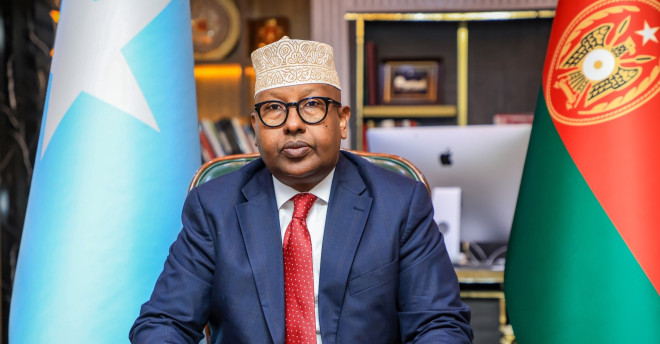 MOGADISHU (Somali Report) — Somali Prime Minister Hamza Abdi Barre on Monday appointed lawmaker Saadaq Omar Hassan, widely known as Saadaq Joon, as the country's new defence minister, removing Ahmed Moallim Fiqi from the position in a limited cabinet reshuffle.
The appointment was announced in a decree issued by the prime minister's office, which also confirmed changes involving two deputy ministers in the federal government.
Saadaq Joon, a member of Somalia's House of the People, the lower chamber of parliament, replaces Fiqi, who had served as defence minister since April 2025.
According to the decree, Barre made the appointment after reviewing Articles 120, paragraphs two and three, of Somalia's provisional constitution and considering advice from President Hassan Sheikh Mohamud.
The prime minister said the decision was necessary to fill the defence ministry position following Fiqi's departure from the post.
Government spokesman Abdinasir Mohamed, who read out the decree to the media, said the reshuffle also involved the exchange of positions between two deputy ministers. Their names and the specific ministries affected were not immediately provided.
The appointment of Saadaq Joon comes amid political changes in the central Somali state of Galmudug, where Liban Ahmed Hassan recently assumed the presidency.
The reshuffle is understood to be linked to clan-based power-sharing arrangements within Somalia's political system. The change in Galmudug's leadership reportedly altered the political balance underpinning Fiqi's continued appointment as defence minister, opening the way for Saadaq Joon to take the position.
Somalia's political appointments are frequently influenced by negotiations over clan representation and power-sharing among political constituencies, particularly when positions in the federal government are distributed among different communities.
Somali Report · Newsletter
Your morning briefing on Somalia's biggest stories — politics, security, business, and the people shaping the region's future.
The cabinet changes come at a sensitive time for the Horn of Africa nation, which is facing a deepening political dispute over the electoral process and the future of its federal political arrangements.
President Hassan Sheikh's administration remains at odds with opposition leaders and some federal member states over proposed electoral changes and the framework for upcoming elections. Efforts to secure an agreement through political dialogue have so far failed to resolve the disagreements.
The dispute has raised concerns about the possibility of further political instability as the country approaches the end of the current federal leadership's term.
The reshuffle also comes as Somalia faces uncertainty over its security arrangements, with foreign troops stationed across the country beginning to withdraw from some positions.
International forces have played a central role in supporting Somali security operations against al-Shabab, the al Qaeda-linked militant group that has waged an insurgency against the federal government for more than 15 years.
The withdrawal of foreign troops has increased pressure on Somali authorities to strengthen national security institutions and assume greater responsibility for protecting key towns and military installations.
The defence ministry oversees the Somali National Army and plays a central role in coordinating military operations, security partnerships and efforts to rebuild the country's armed forces.
It was not immediately clear whether the new minister would announce changes to the ministry's leadership or military strategy following his appointment.
The latest reshuffle represents a change in one of the government's most important security portfolios at a time when Somalia is dealing with both mounting political disagreements and continuing security challenges.
About the Author
Ahmed Omar is a senior journalist for Somali Report, based in Mogadishu. He has two decades of experience reporting on Somalia for international and local media. He covers politics, security, governance, business, trade, economic developments and regional affairs.
